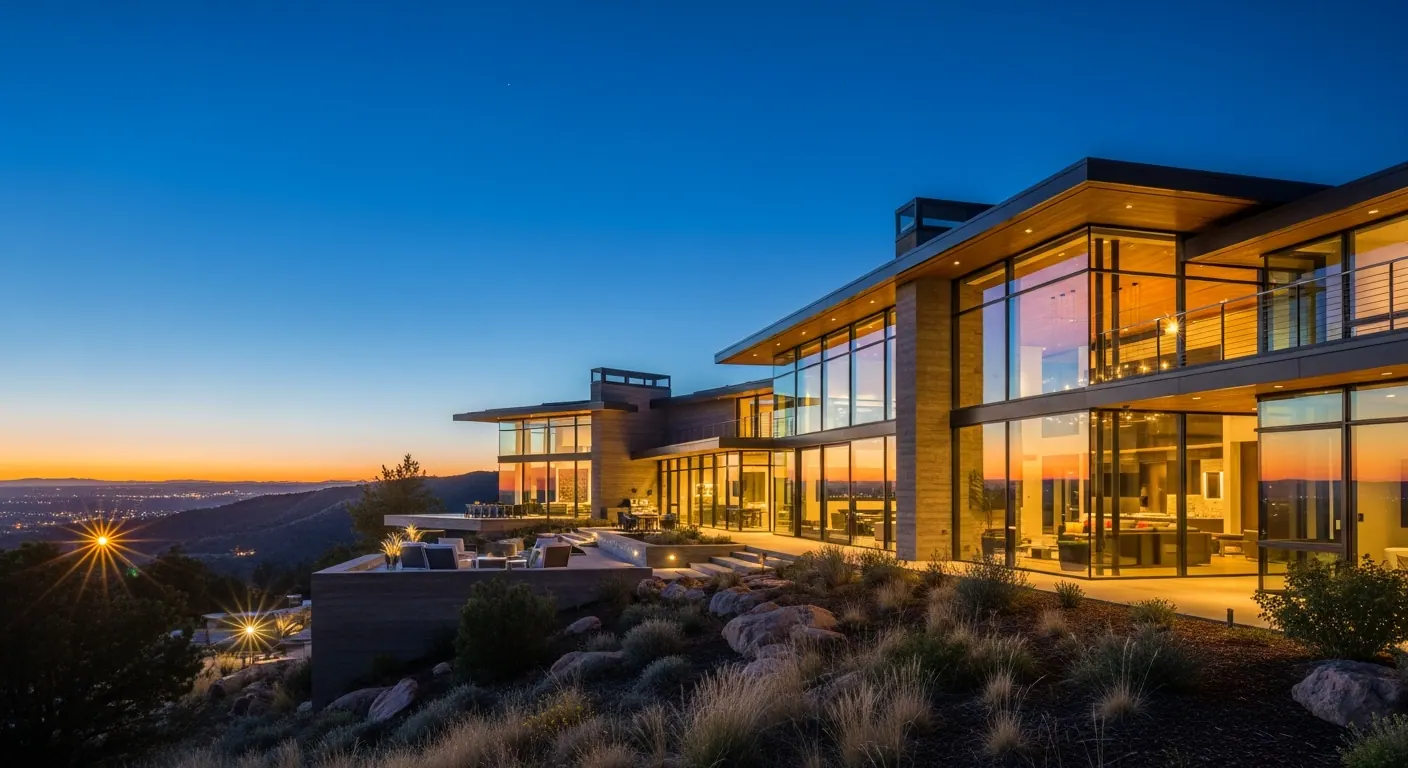
What's My Denver Home Worth? Understanding Luxury Valuations
Why Zestimate and Redfin Estimate fail above $3M in Denver - what actually moves a Cherry Hills appraisal, how a defensible luxury comp set is built, and when to push back.

The 2026 Denver investment thesis
If you have searched your Denver address on Zillow or Redfin in the last few weeks, you have an estimated value that is almost certainly wrong if your home is above the $3 million mark. Not approximately wrong - meaningfully wrong, sometimes by 10 to 25 percent. The automated valuation models that power the Zestimate and similar tools are accurate enough at median price points to be useful, and inaccurate enough at the luxury tier to be misleading. This is not a knock on Zillow's engineering. It is a function of how the models work, what data they have access to, and how the Denver luxury market is structured.
Why Automated Valuations Fail Above $3M
Automated Valuation Models, or AVMs, work by finding comparable recent sales and adjusting for differences. The models are excellent at this when there is dense comparable data - a typical Wash Park bungalow that closed last quarter has dozens of legitimate comps within a half mile and within the last twelve months. The model has plenty of signal to work with. At the $3 million-plus tier in Cherry Hills Village, Polo Club, Hilltop, or Cherry Creek, that comparable density disappears. A specific Cherry Hills new-construction estate at $7 million may have three to five legitimate comps in the entire metro from the past twelve months, several of which are off-market transactions that the AVM cannot see at all. Without dense, on-market comparable data, the model falls back on broader regional trends and feature-level pricing - which is exactly the wrong methodology for a luxury property. A second compounding factor: luxury sales include extensive customization, view premiums, lot premiums, architectural significance, and finish-level variations that the model cannot price. Two Cherry Hills homes on the same street, both seven bedrooms and roughly the same square footage, can legitimately trade $2 million apart based on factors the AVM has no signal for. The model averages them. The market does not. The third issue, which matters specifically in Denver: a meaningful share of luxury transactions at the highest tier - somewhere in the 15 to 25 percent range across recent years per market participant estimates - happens off-market entirely. Those sales never reach the public data feed the AVM ingests, so the model is working with a structurally incomplete picture of true market activity.
What Actually Moves a $5M Cherry Hills Appraisal
When I work with a seller pricing a Cherry Hills Village, Polo Club, or Hilltop home above $3 million, the comp set that drives the realistic listing price is built from six factors. The AVM weights two of them. Manual valuation weights all six. Recent closed sales of similar product. This is the AVM's only real input - and even here, the AVM is working with the broader public closing data, not the granular finish-level data a knowledgeable agent will assemble. Off-market transaction knowledge. What did the Cherry Creek brokerage community move off-market in the last six months that did not appear in the MLS? This is relationship-driven information, and it is not optional at the luxury tier - it materially shifts the realistic price range. Lot characteristics that the AVM treats as roughly equivalent. A north-south oriented one-acre lot in Cherry Hills with mature trees and a westerly view trades meaningfully different than an east-west oriented lot of the same square footage on the same street. The AVM cannot price this. Finish level and recent capital improvements. The model knows you have a kitchen. It does not know whether the kitchen is a builder-grade 2015 finish or a 2023 custom-millwork-and-Wolf-range execution. The pricing difference between these two on otherwise equivalent homes can be $200,000 to $500,000 in Cherry Hills. Architectural significance. A documented architect-designed home - whether by a name architect or simply a custom-design with documented provenance - prices differently than the same-square-footage builder spec. The AVM is blind to this. Active competing inventory and recent withdrawals. What other Cherry Hills homes in the same price band are currently listed? Which ones were pulled from the market in the last six months? These are leading indicators for where the ceiling currently sits, and they shape strategy more than they shape price - but they belong in any honest valuation conversation.
Building a Defensible Luxury Comp Set
When I price a luxury Denver home for a seller, the working comp set typically includes: The output is not a single number. It is a range with a recommendation for where to start, what the realistic settling point looks like, and what the downside looks like if the property sits. A defensible $5 million Cherry Hills CMA will be a 30-page document. A Zestimate is a single number with no methodology. They are not the same product, and treating them as substitutes is the single most common pricing mistake I see Denver luxury sellers make.
When the Appraisal Comes In Low - And What to Do
Even after the property goes under contract at a defensible price, the lender's appraisal can come in lower than the contract price - particularly at the luxury tier where appraisers themselves face the same comparable-density problem as the AVMs. A material share of $3 million-plus Denver transactions in any given quarter face appraisal challenges. The honest path through this is not to argue with the appraiser. It is to provide the appraiser with the comp set that supports the contract price - specifically the same kind of granular, factor-adjusted documentation a proper CMA would contain. Appraisers will adjust their reports when presented with credible additional comparable data they did not have. They will not adjust based on argument. If the appraisal still comes in low after that, the seller and buyer have three real options: the seller reduces price to the appraised value, the buyer brings additional cash to cover the gap, or the parties negotiate a middle ground. In Denver luxury markets in 2026, the gap is most often shared - not because there is a rule, but because that is what the cleanest closings look like.
Cash Offers and the Appraisal Question
A growing share of $3 million-plus Denver transactions are cash. For cash buyers, the appraisal question disappears entirely - which is one of the reasons sellers commonly accept a 1 to 3 percent discount on a cash offer relative to a comparable financed offer. The buyer pays less; the seller gets certainty and a shorter close. Both sides win something. For sellers, this is part of why the cash offer landscape matters at the luxury tier. A $5.2 million all-cash offer often nets better than a $5.4 million financed offer because of the appraisal risk, the contingency reduction, and the shorter close timeline. Pricing for the right buyer pool is part of the valuation strategy, not separate from it.
What This Means If You Are Considering Selling
A few practical takeaways for Denver luxury sellers thinking about value: The Zestimate is a starting point for a conversation, not a basis for a listing decision. Treat it as the median-priced-home tool it actually is, not as a luxury valuation tool. Get a real CMA from an agent who works your specific submarket. Cherry Hills, Polo Club, Hilltop, Wash Park, and Cherry Creek each operate on their own comp logic. An agent who does not work the specific neighborhood on a weekly basis will produce a CMA that is closer to a Zestimate than to a defensible price. Build the off-market intelligence in. The off-market layer in Denver luxury is real and material. A valuation conversation that ignores it is incomplete. Plan for the appraisal challenge in advance. Especially at $3 million-plus, the lender's appraisal will need help. Building the comp documentation early - before the appraiser is on site - is part of the listing strategy, not a reaction to a problem. If you are considering selling a Cherry Hills, Polo Club, Greenwood Village, Hilltop, Wash Park, or Cherry Creek property, the first conversation should not be about price. It should be about timeline, motivation, and what the realistic net-proceeds picture looks like. The price is downstream of those, not the lead. Reach out via the contact page for a private valuation conversation. There is no template - every conversation starts with what you are actually trying to accomplish.