Washington Park vs Bonnie Brae vs Platt Park: Choosing Your Denver Neighborhood
Washington Park, Bonnie Brae, and Platt Park are three adjacent central Denver neighborhoods often weighed against each other by buyers looking for established character, walkability, and South High School access. They share much of the same housing era and feed into many of.

The 2026 Denver investment thesis
Washington Park, Bonnie Brae, and Platt Park are three adjacent central Denver neighborhoods often weighed against each other by buyers looking for established character, walkability, and South High School access. They share much of the same housing era and feed into many of the same secondary schools - but they live differently day to day. Wash Park is anchored by the park that gives it its name. Bonnie Brae is a small, intimate enclave with curved streets and an outsized cultural footprint. Platt Park is the most commercially active of the three, built around the Old South Pearl Street corridor. This guide walks through how they sit together geographically, what to expect from each, how schools and walkability compare, and which buyer profile tends to land where.
Geography: How the Three Neighborhoods Sit Together
All three fit inside a compact slice of central south Denver, close enough that residents routinely walk or bike between them - and close enough that buyers shopping this part of the city should tour all three before deciding. Washington Park is bounded roughly by University Boulevard on the east, I-25 on the west, Louisiana on the south, and Alameda on the north (the park itself runs along Downing, which divides the Washington Park and Washington Park West sub-neighborhoods). The park itself runs north-south through the middle for roughly 1.5 miles and is the largest civic green space in central Denver. Bonnie Brae sits immediately southeast of Wash Park, between University Boulevard and Wash Park's residential blocks, roughly between Mississippi and Exposition avenues. It is the smallest of the three by a wide margin - only a handful of square blocks. Platt Park sits south of Wash Park, bounded by Broadway on the west, Downing on the east, Mississippi Avenue on the north, and Evans on the south. The Old South Pearl Street commercial strip runs north-south through the middle. All three are well-served by Broadway buses, the I-25 light rail stations at Louisiana/Pearl and Evans, and bike infrastructure along Marion Street Parkway and the Cherry Creek trail. A typical commute to LoDo runs fifteen minutes by car, twenty by light rail.
Washington Park
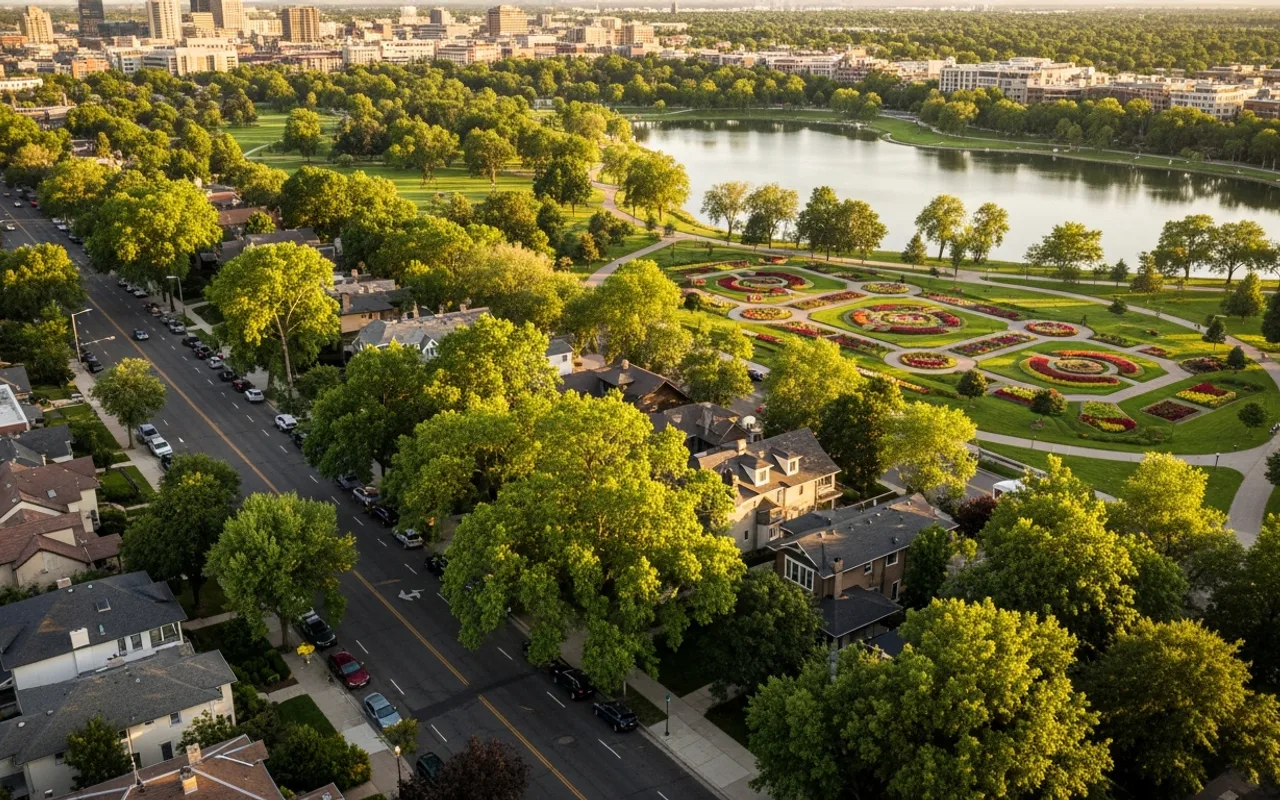
Wash Park is what most buyers picture when they imagine an established Denver family neighborhood. The park itself is the defining amenity and the reason prices have held the way they have. Two lakes, formal flower gardens, a 2.6-mile perimeter loop used hard by runners and cyclists, lawn-sport space, a recreation center, and tennis courts all sit inside it. On a warm Saturday in summer, the park sets the rhythm of the neighborhood. The housing stock dates mostly to the 1900 - 1940s era. You will see Denver Squares (the boxy two-story foursquare that defines a lot of pre-war Denver), brick bungalows, English Tudors, and a smaller subset of mission-style and Craftsman homes. Many original homes have been renovated multiple times; a meaningful share have been scraped and replaced with larger custom builds, particularly on the blocks closest to the park. Lot sizes tend to be larger than what you will find in Bonnie Brae or Platt Park - typically 4,500 to 7,500 square feet on standard residential blocks, with larger lots on park-facing streets. Schools assigned to Wash Park addresses through Denver Public Schools generally include Steele Elementary, Merrill Middle, and South High School, though the exact assignment depends on the block and DPS's choice system can route students elsewhere. South High, the shared secondary anchor for all three neighborhoods, sits on Louisiana Avenue at the south edge of Wash Park. Commercial life centers on Old Gaylord Street, a small two-block stretch on the eastern edge where you'll find a handful of long-running restaurants, a bookshop, coffee, and casual dining. It is intentionally low-key - Wash Park is not a walking-commercial neighborhood the way Platt Park is. The park is the amenity; the dining is supplemental. Pricing tends to run at the top of the three, especially for blocks within two or three streets of the park itself. Directionally, expect Wash Park to demand a premium over comparable square footage in Platt Park, with Bonnie Brae sometimes matching it on a per-square-foot basis for smaller, well-positioned homes. Specific market figures move with the cycle and are worth confirming against current MLS data.
Bonnie Brae
Bonnie Brae is the smallest of the three by area and the most distinctive in feel. The defining geographic feature is its street layout: instead of Denver's strict north-south, east-west grid, Bonnie Brae's streets curve. The neighborhood was platted in the 1920s on land that had been a flower farm, and the developer laid out crescents and gentle arcs rather than a grid. The result feels intimate, almost cul-de-sac-like, even though there are no actual gates. Bonnie Brae Park is a small neighborhood green space at the center of the enclave - not comparable to Washington Park, but a real gathering point for the families who live there. The cultural anchors that gave the neighborhood its outsized identity are commercial: Bonnie Brae Ice Cream on University Boulevard has been a Denver institution for decades and is still operating. The long-running Bonnie Brae Tavern, which opened in 1934 and stayed in the same family for three generations, closed in 2022 after 88 years - the closing was a meaningful local moment, and the corner where it stood remains part of the neighborhood's identity. The housing stock skews to the same pre-war era as Wash Park - bungalows, Tudors, brick foursquares - but on tighter lots. Lot sizes often run 4,000 to 5,500 square feet, noticeably more compact than typical Wash Park blocks. Because the lots are smaller and the neighborhood is geographically constrained, you will see fewer aggressive scrape-and-build projects than in Platt Park, though some larger custom builds have gone up where original homes came down. Schools through DPS generally route Bonnie Brae addresses to Slavens K-8, a single school covering kindergarten through eighth grade that is one of the more sought-after DPS programs in this part of the city. From there families feed into South High School. The Slavens factor is one of the reasons families with young children sometimes specifically target Bonnie Brae over Wash Park. On a total-price basis, Bonnie Brae is often slightly less than Wash Park because lot sizes and home sizes are smaller. But on a per-square-foot basis, Bonnie Brae frequently matches or exceeds Wash Park, particularly for renovated bungalows on the curved interior streets. Inventory is genuinely scarce - homes turn over slowly here because long-time owners tend to stay.
Platt Park
Platt Park sits south of Wash Park, running from roughly Mississippi to Evans, with Broadway on the west and Downing on the east. The center of gravity is Old South Pearl Street, a several-block commercial corridor that has become one of the more active walkable dining and shopping scenes in central Denver. The South Pearl Street Farmers Market runs Sundays from roughly May through November and pulls customers from across the city. The corridor includes coffee shops, a long-running breakfast institution, independent restaurants across multiple price points, a wine bar, retail boutiques, and a small theater. The walk-to-dinner dynamic on Pearl is the strongest of the three neighborhoods. The housing stock is similar in era to Wash Park and Bonnie Brae - turn-of-the-century to 1940s bungalows, Denver Squares, and Tudor revivals - but Platt Park has seen substantially more redevelopment over the past fifteen years. Scrape-and-build activity is meaningful here. It is common to walk a single block and see a 1910 bungalow next to a 2018 modern infill. Buyers shopping Platt Park need to be clear about whether they want historic character or new construction; both exist in volume. Lot sizes generally run 4,000 to 5,500 square feet, similar to Bonnie Brae and a notch tighter than Wash Park. Alley access is common, garages are typically detached, and many of the newer builds maximize the footprint up to setback lines. Schools assigned to Platt Park addresses through DPS generally include Asbury Elementary and Grant Beacon Middle School, with South High as the shared secondary feeder. Asbury has a strong local reputation; Grant Beacon is one of DPS's middle school programs frequently chosen through the choice system from outside its boundary. Of the three neighborhoods, Platt Park is often the most attainable for buyers comparing similar square footage - though "attainable" here is relative. The combination of stronger commercial walkability, slightly lower pricing, and active redevelopment makes Platt Park particularly attractive to younger buyers, professional couples without children yet, and downsizers who want a neighborhood scene without the lot maintenance of Wash Park.
Walkability and Amenities
Walkability differs meaningfully across the three. Wash Park's amenity is the park itself. If your ideal Saturday is a morning run around the perimeter loop, a walk to coffee on Old Gaylord, and an afternoon under a tree, Wash Park delivers it on foot. What it does not deliver is dense commercial walkability - Old Gaylord is two blocks, not twenty. Bonnie Brae has the weakest commercial walkability of the three. The Bonnie Brae Ice Cream corner is genuinely walk-to; beyond that, residents drive or walk into Wash Park's Gaylord strip or up to University for retail. What Bonnie Brae offers instead is the quietest residential streetscape - the curved streets, low traffic, and small scale create a strong walking neighborhood without much commercial pull-through. Platt Park has the strongest commercial walkability. Old South Pearl is a destination strip - Sunday market in season, coffee in the morning, dinner at night. Buyers who specifically want to walk to dinner most nights gravitate here over the other two. For cyclists, all three feed into the same regional infrastructure: the Cherry Creek trail to the north, the Marion Street Parkway bike lanes, and short connections to the High Line Canal southeast.
Which Fits Which Buyer
These neighborhoods are alternatives, but not interchangeable: Lean Washington Park if: you want a park as a daily amenity, larger lots and bigger pre-war homes, a traditional Denver family-neighborhood feel, and you are willing to pay at or near the top of the three. The buyer profile here often skews toward established families and households trading up from elsewhere in Denver. Lean Bonnie Brae if: you want a smaller, more intimate enclave with strong historic character, you specifically value the Slavens K-8 program, you can accept smaller lots for the trade-off of the curved-street scale, and you prefer a quieter residential experience to a commercial-walk one. Buyers who choose Bonnie Brae often choose it on the second or third visit. Lean Platt Park if: you want the strongest walkable commercial scene of the three, attainability on a square-foot basis matters, and you are comfortable with a neighborhood that mixes original historic homes with significant new construction. Younger professionals, couples without children yet, and downsizers wanting a scene without lot maintenance tend to do well here. The mistake worth avoiding is buying one of these neighborhoods for the wrong reason - choosing Wash Park for walkability when Platt Park would have suited better, or choosing Platt Park for quiet when Bonnie Brae's curves would have fit. Walking all three before deciding takes a single afternoon.
Working with a Local Denver Broker
I've spent my career working central Denver, and these three neighborhoods come up almost daily in buyer conversations. They get conflated, compared on the wrong axes, and sometimes chosen for reasons that don't hold up six months into living in the home. The right decision usually comes from walking all three on the same afternoon, talking through how you actually spend a Saturday, and matching the neighborhood to the life rather than the other way around. If you want a no-pressure walkthrough of all three - including current inventory, school assignment verification, and an honest read on where each is trading - reach out directly. Rick Janson - Compass, Denver. Denver Lifestyle network.